Three problems, three jobs
| Problem | What is needed | Typical material |
|---|---|---|
| Fill mixing into soft ground | Separation between the ground and the first layer of fill | Nonwoven geotextile |
| Water squeezed out of the clay as it settles | A drainage path, kept free of silt | Granular blanket wrapped in nonwoven, vertical drains |
| The bank sliding or spreading | Tensile reinforcement at the base | High-strength woven geotextile or geogrid |
We make the first and the filter part of the second. Basal reinforcement is a structural design using high-strength woven fabric or geogrid, which we do not make. A bill of quantities that keeps these apart avoids a separation fabric being asked to hold up a bank.
Separation at the base
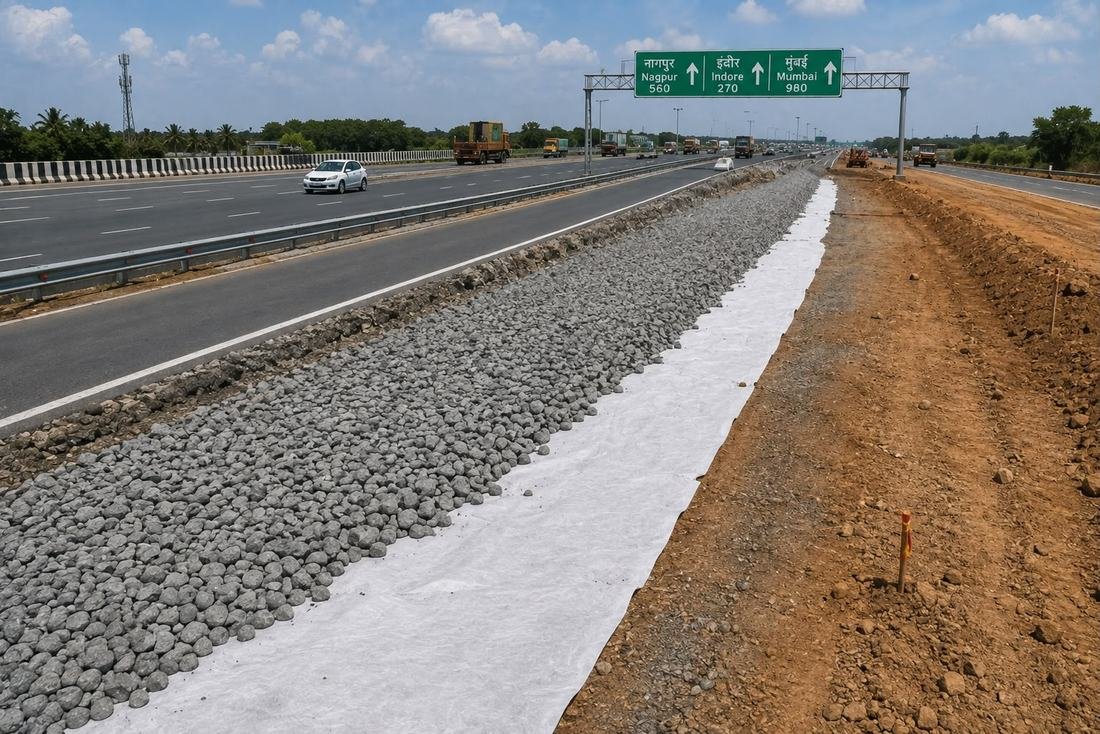
The first layer of fill is pushed into soft ground by its own weight and by the plant working on it. Without a barrier, stone and soil mix, the fill loses thickness, and more fill is needed to reach level. A nonwoven laid on the prepared ground keeps the two apart, so the fill placed stays where it is put.
This is the same separation job described in our geotextile for road construction guide, only under a deeper fill and often on wetter ground.
Drainage while the ground settles
As fill goes on, soft clay slowly squeezes out water and settles. Designers often speed this up with a sand or gravel drainage blanket at the base, sometimes with vertical drains pushed into the clay below. That water has to escape without carrying fine soil into the blanket and clogging it.
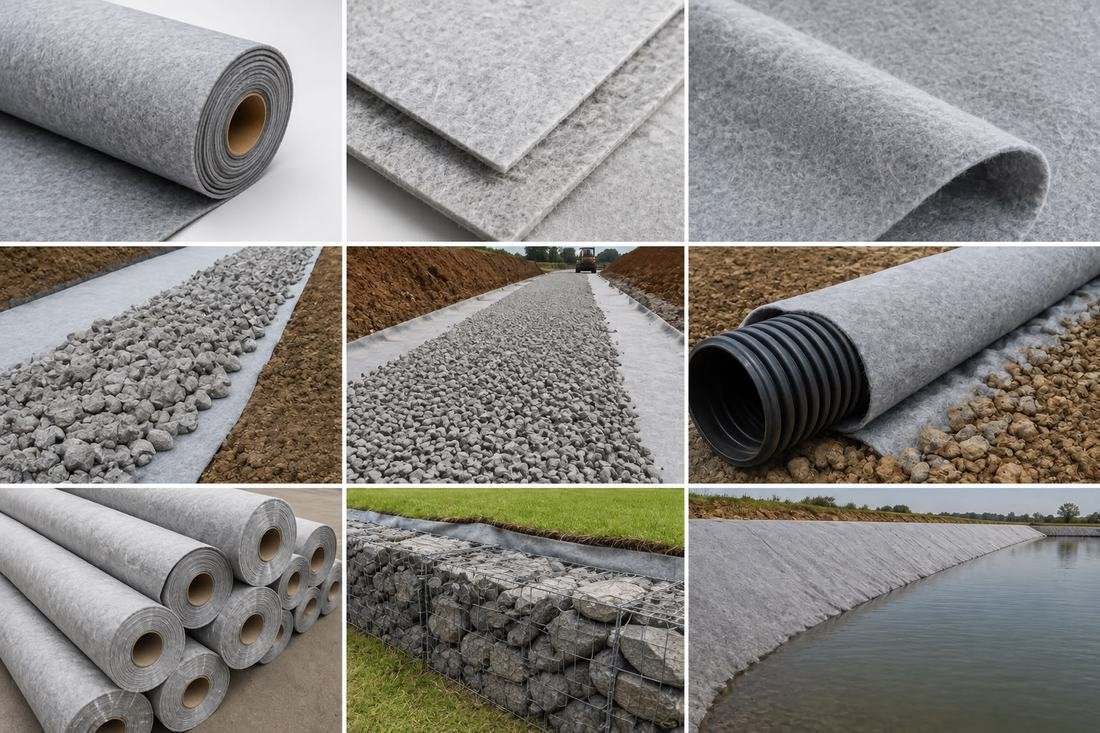
A nonwoven geotextile around or under the blanket does the filtering: water passes, silt stays back. The opening size and permeability are chosen against the soil, as in our drainage and erosion control guide.
Side slopes and toe
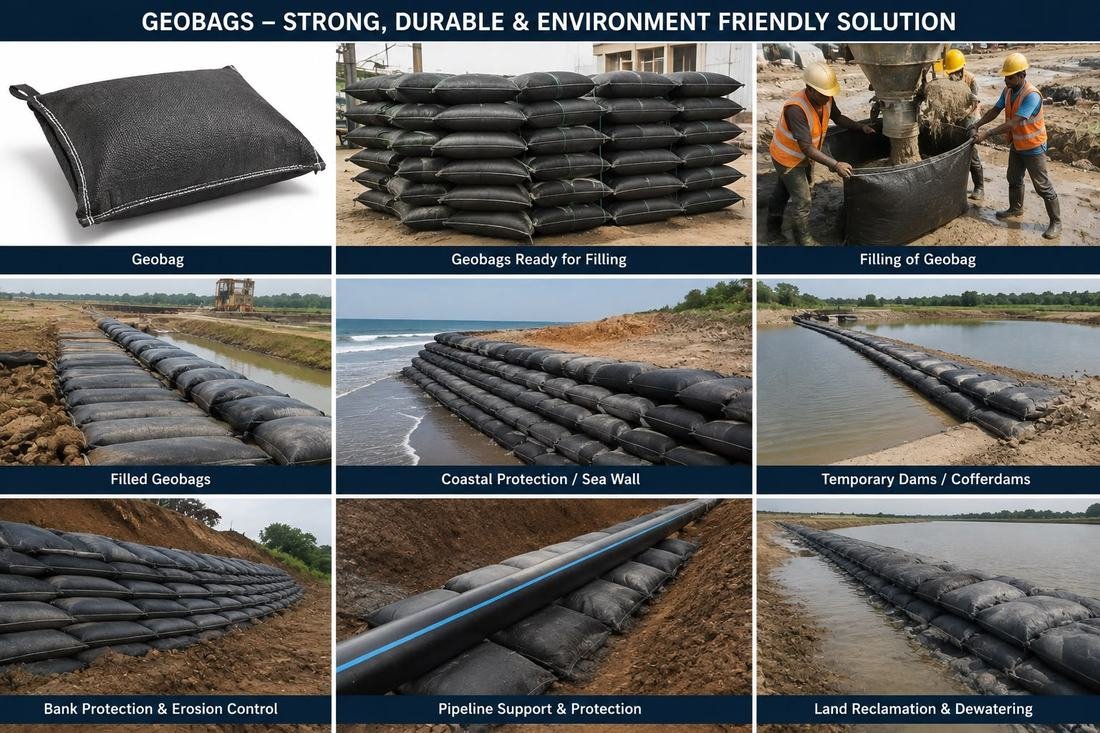
On the side slopes, the nonwoven is used under stone pitching or turfing to stop rain and floodwater washing the fill out. At the toe, it wraps drains that take water away from the bank. On river and coastal bunds, sand-filled bags made from the same fabric are used for toe protection; see our geobag fabric guide.
What decides the specification
- The soil: how soft it is, its fines content, and the water table
- The fill and the size of the first stone placed on the fabric
- Construction plant working directly over the fabric
- Whether the fabric also filters, and against which soil
Mass per unit area, puncture strength, opening size and permeability follow from these, so the design sets them. Where your specification cites a standard or code of practice, confirm the current edition with your engineer and send us the clauses that apply to the fabric. We produce to the specification rather than setting design values ourselves.
What to send with your enquiry
- The work: highway, rail, bund, approach embankment, platform
- The job of the fabric: separation, filtration around a blanket, slope protection
- Design values: GSM, puncture strength, opening size, permeability, polymer
- Roll width suited to the embankment width, total area, and delivery location
Send it through the enquiry form; samples are available on request. For roll quantities from an area, see geotextile roll weight and coverage.
Questions
Why is geotextile used under an embankment on soft soil?
Mainly to separate the fill from the soft ground so the two do not mix, and to filter water leaving the ground through a drainage blanket. Where the bank also needs reinforcement against sliding, that is done with high-strength woven geotextile or geogrid.
Is nonwoven geotextile strong enough to reinforce an embankment?
Nonwoven geotextile is used for separation, filtration and drainage, not as the main reinforcement of a high embankment on soft clay. Basal reinforcement is designed separately and uses high-strength woven fabric or geogrid.
Can geotextile be used on black cotton soil?
Yes. It is commonly used as a separation and drainage layer over expansive soils such as black cotton soil, under roads and embankments. The project design sets the grade.
What GSM geotextile is used for embankments?
It depends on the soil, the fill, the stone size and the plant working on it, so the design decides. We produce from 100 to 1200 GSM to the specification you send.
Do you supply geogrid or high-strength woven geotextile?
No. We make needle punched and thermal bonded nonwoven geotextile. Reinforcement materials come from other suppliers, and we quote only our part.