Filtration and drainage, not just separation
A drainage geotextile does two things at once that pull against each other. It must be open enough that water moves through it without building pressure, and tight enough that fine soil particles do not wash through and silt up the drain behind it.
A needle punched nonwoven suits this because it is thick and three-dimensional. Water passes through the plane of the fabric and can also move along it, while the tangled fibre structure holds back fines. Separation is covered more broadly in our nonwoven geotextile guide; this page is about the filtering jobs.
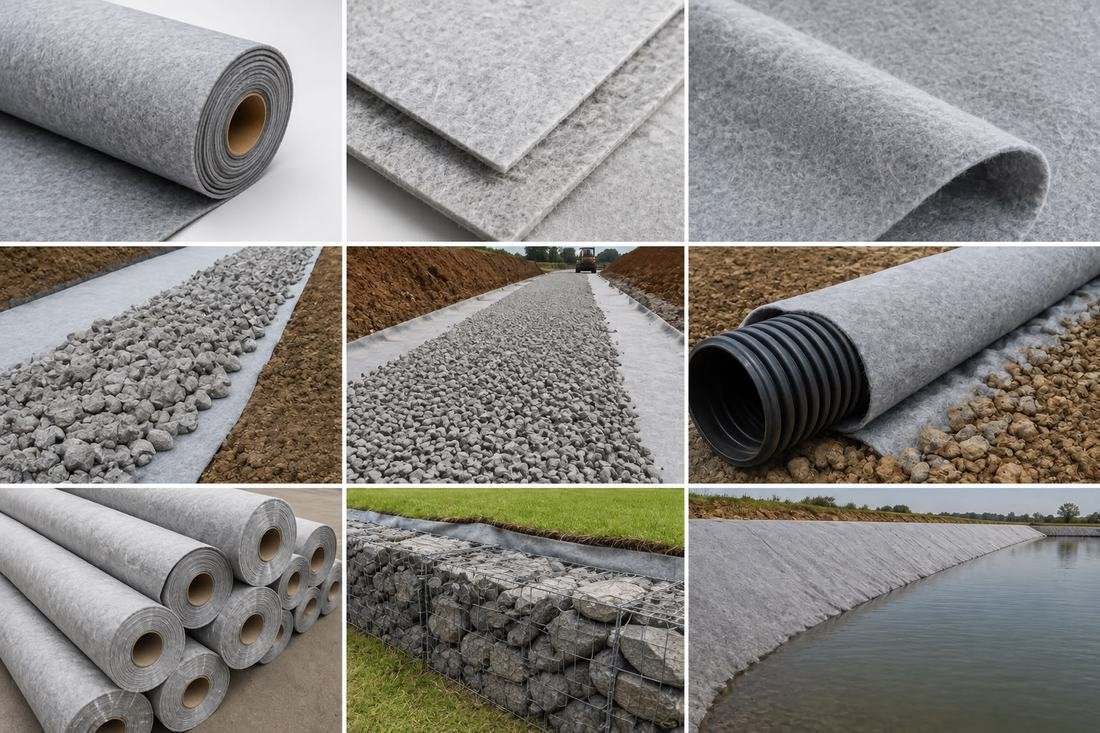
Where drainage geotextile is used
- French drains — lining the trench so the stone stays clean
- Subsurface and trench drains under roads, yards and sports fields
- Wrapping perforated pipe, so the perforations do not block with fines
- Behind retaining walls, where water has to escape instead of loading the wall
- Slope and embankment protection, under rock or soil cover
- Canal, pond and reservoir banks
- Rainwater-harvesting structures and landscaping and garden drainage
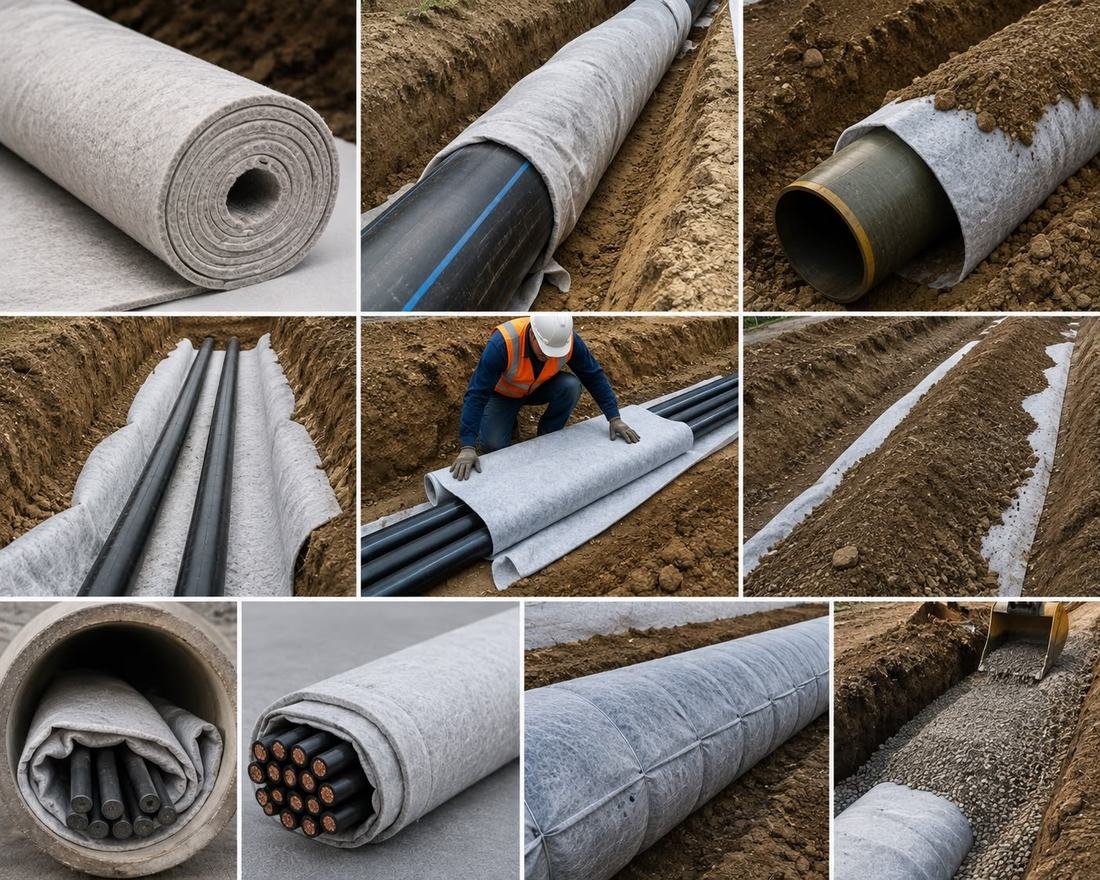
Our drainage and soil erosion control geotextile is made for these applications, and pipeline and cable protection geotextile covers the related job of cushioning buried utilities against sharp backfill.
The filtration balance: retain soil, pass water
Two properties describe the balance. Permeability, usually expressed for geotextiles as permittivity, says how readily water crosses the fabric. Opening size — reported as apparent opening size or as O90 depending on the standard — says how large a particle can pass. A good filter has an opening size small enough to retain the soil it faces and a permeability comfortably higher than the soil’s own.
The numbers that matter follow from the soil, not from the fabric. Fine silts and clays need a tighter filter than a sandy gravel, and a project design will normally state the required values. Send those values with your enquiry; where a design has not set them, describe the soil and the drain and we will discuss what suits.
Wrapping a drain or a perforated pipe
- Line the trench before the stone goes in, with enough fabric to fold over the top of the backfill
- Lap joints generously — figures in the region of 300 mm are commonly specified, but the project detail governs
- Keep soil, mud and site traffic off the fabric face while it is open
- Lay it to the trench profile without stretching it taut across voids
- Cover it soon after laying, rather than leaving the drain open for days
Installation details are the engineer’s to set, and the figures above are general practice rather than a specification. Follow the drawings for your project.
Slopes, embankments and erosion control
On a slope the failure to prevent is washout: rainwater runs over or through the surface and carries soil with it. A geotextile placed under rock armour, gabions or a soil cover holds the ground surface together, lets water pass without pressure building behind the cover, and keeps the cover material from sinking into the soil.
The same reasoning applies on canal and pond banks, and behind retaining walls, where water that cannot escape becomes a load on the structure. The fabric has to survive placement — stone dropped on it, plant tracking over it — so weight is chosen for the installation as much as for the filtration.
Durability underground, and exposure above it
Polypropylene and polyester nonwovens are resistant to moisture, rot, biological attack and most soil chemistry, which is why they last in a buried drain. Polyester vs polypropylene sets out how the two differ.
Sunlight is the one real weakness. Geotextiles lose strength with prolonged UV exposure, which is why they are specified to be covered soon after they are laid. If your programme means fabric will stay open for an extended period, say so when you enquire so it can be factored into the material and the handling.
What to settle before you order
- The function — filtration, drainage, erosion control, or a combination
- Soil type at the interface, and the water flow you expect
- Any permeability, permittivity, opening size or strength value the design requires
- GSM and thickness, as set by that design
- Roll width and roll length, matched to the trench or slope layout so overlaps and waste work out
- Fibre — PP (virgin or recycled) or polyester
- Quantity, destination port and any test certificate your market requires
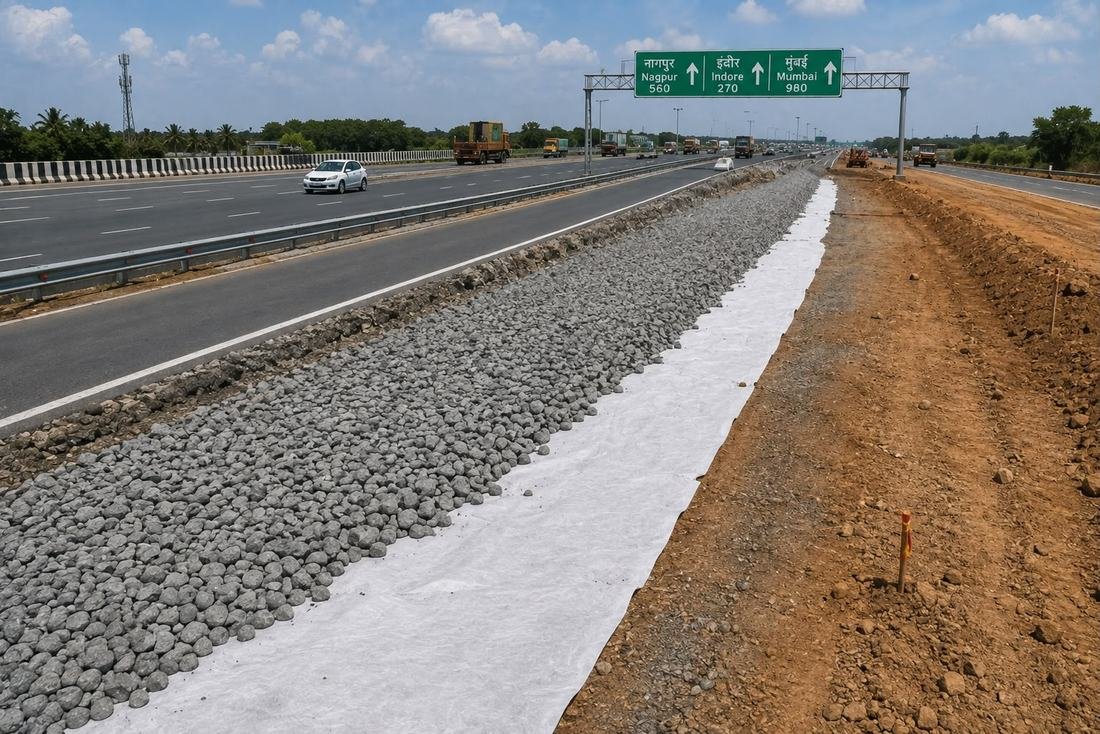
Material is made to order from 100 to 1200 GSM in roll widths of 5.0–5.2 m. Send the application, the design values and the quantity through the enquiry form; samples are available on request. If you are also laying fabric under a carriageway, read geotextile for road construction.
Questions
Which geotextile is used for a French drain?
A needle punched nonwoven geotextile, because water passes through its thickness while the fibre structure holds fine soil back. The weight and opening size depend on the soil at the trench face and on the project design.
Woven or nonwoven geotextile for drainage?
Nonwoven, for drainage and filtration. A thick needle punched fabric lets water move through and along it, which is what a drain needs. Woven geotextiles are generally chosen where tensile strength and reinforcement matter more than flow. See woven vs nonwoven geotextile.
What GSM is needed for drainage geotextile?
It follows from the soil, the flow and the installation conditions rather than from a standard figure, and a project design will usually state it. We produce from 100 to 1200 GSM to the specification you supply, and can discuss a weight if the design has not set one.
Can geotextile be left exposed to sunlight?
Only briefly. Prolonged UV exposure weakens the fabric, so geotextiles are normally specified to be covered soon after laying. If the fabric has to stay open for longer on your site, tell us when you enquire.
How much overlap is needed at a joint?
That is set by the project design. Figures in the region of 300 mm are commonly specified for drains, with more where the ground is soft or uneven, but follow the engineer’s detail for your site.