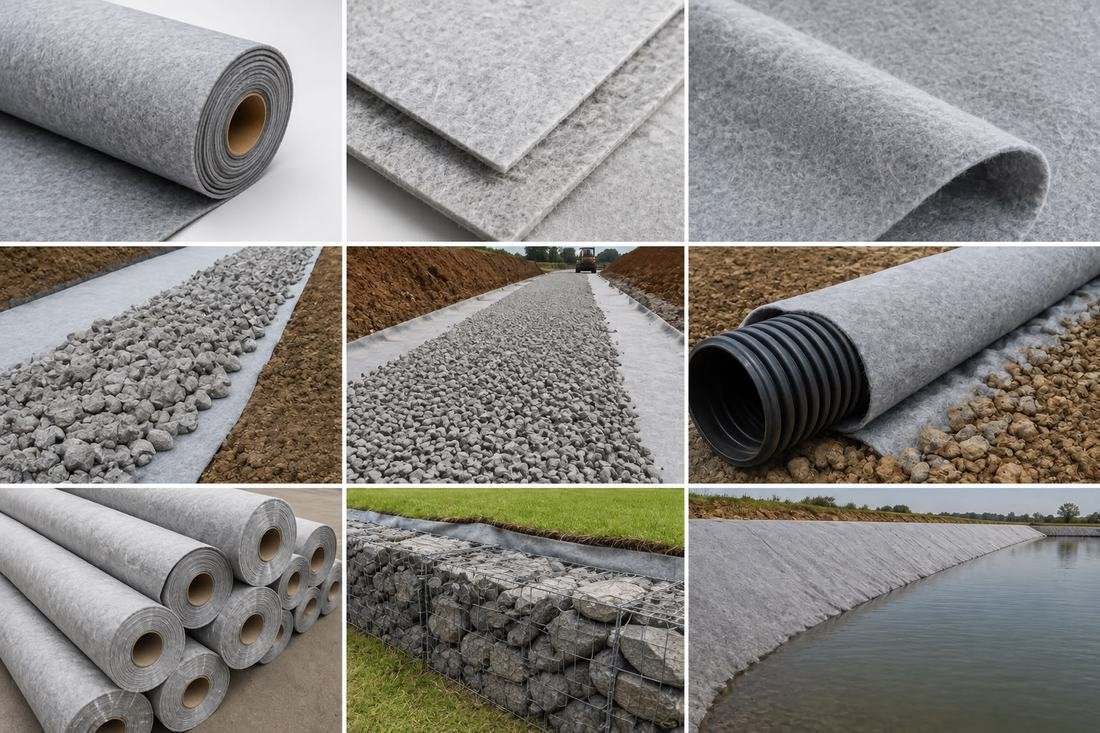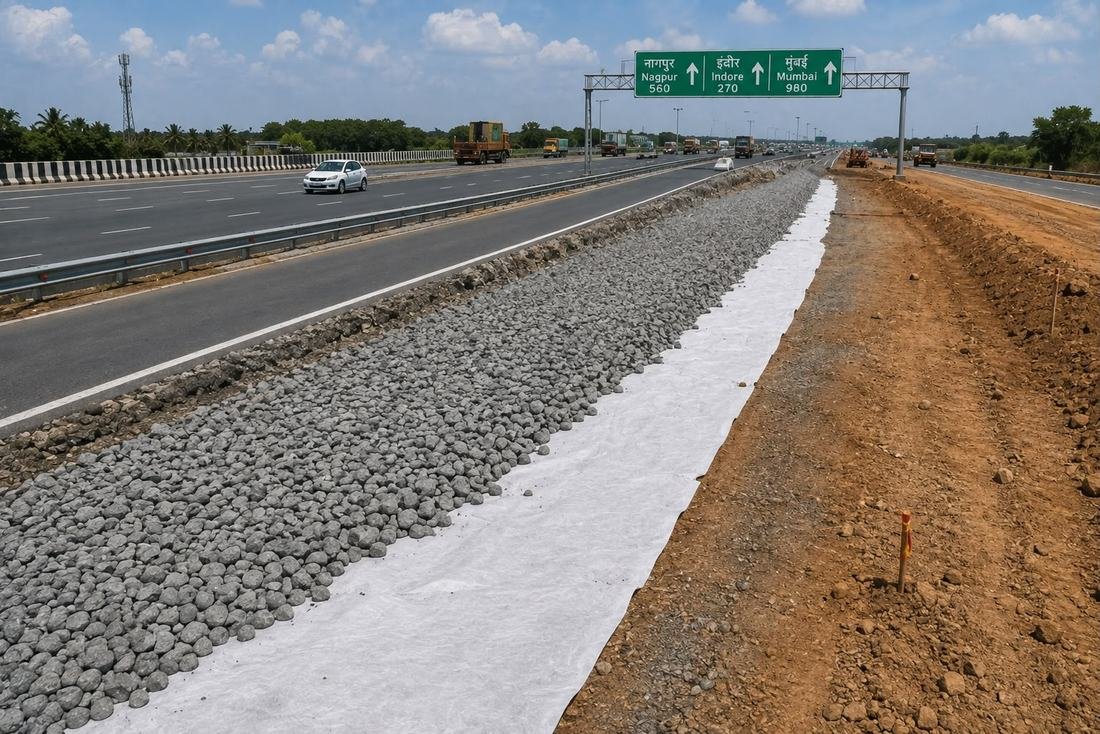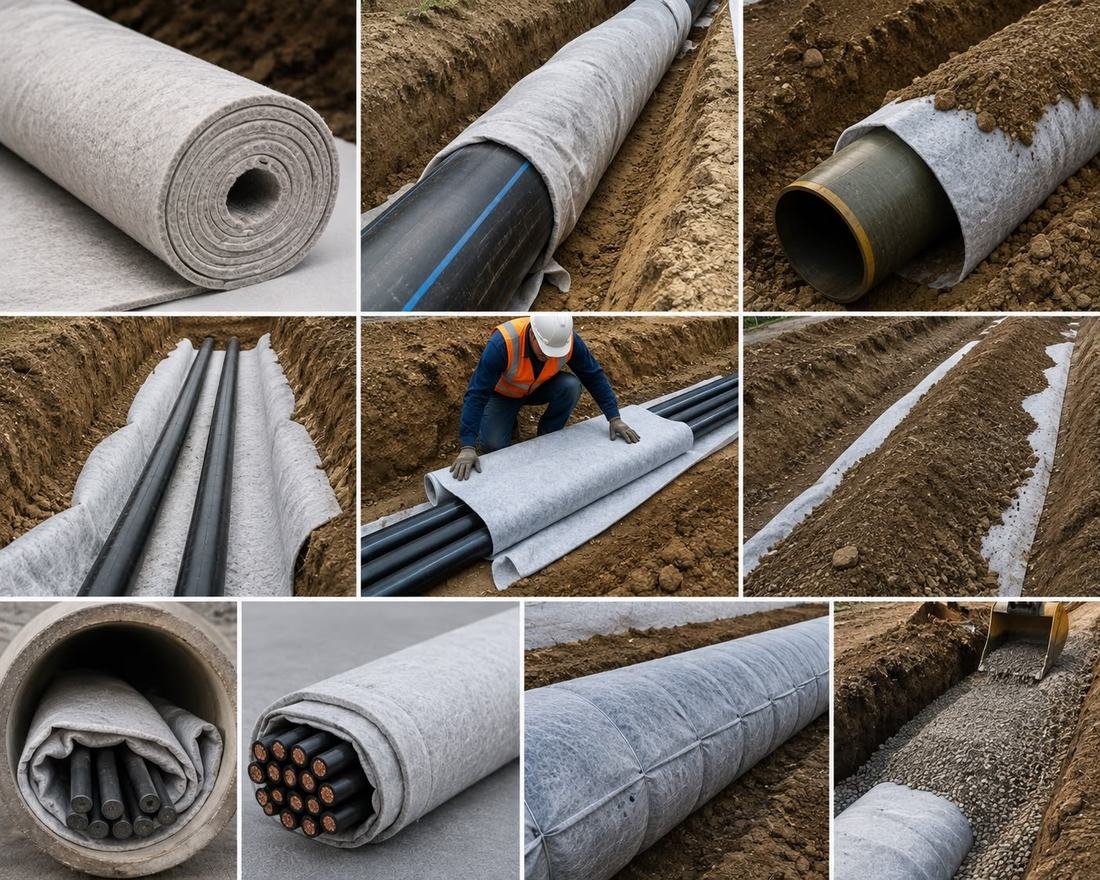
Why water behind a wall matters
Water that cannot escape adds pressure on the wall on top of the push from the soil itself. In a monsoon, soil behind a wall can be saturated for weeks. Walls fail far more often from trapped water than from the soil alone, which is why nearly every retaining wall design includes drainage.
What the geotextile does
- Filtration — lets water into the drainage layer and holds soil particles back
- Separation — stops the drainage stone from mixing into the soil
- Protection — cushions a membrane or pipe against sharp stone, where one is used
The drainage layer works only while it stays open. If fine soil washes into the stone, the voids fill, flow slows and pressure builds. A needle punched nonwoven geotextile is placed between the retained soil and the drainage layer as a filter: water passes through it, soil stays behind it.
Where it goes
- On the soil side of the drainage stone or drainage board, wrapped so the stone is enclosed
- Around the perforated pipe at the toe or base of the wall, with the pipe inside a stone surround
- In front of weep holes, so soil is not carried out through the opening
- Under the base stone of some walls, as a separator over soft ground
The exact arrangement is shown on the design drawing. Follow it, and ask the project engineer if the drawing does not name the fabric.
Common mistakes
- Leaving the fabric out, so fines clog the stone within a few seasons
- Using an impermeable plastic sheet instead of a permeable geotextile, which blocks the very water the drain is meant to carry
- Choosing a fabric by appearance, not by the weight and filtration figures the soil needs
- Not overlapping or wrapping the stone properly, which leaves a path for soil to reach it
- Leaving the fabric uncovered in sunlight; polypropylene is sensitive to prolonged UV exposure
Roads in the hills and on slopes
Retaining walls on hill roads, ghat sections and embankments face steep slopes and heavy runoff, and many walls are built from stone masonry or gabions with weep holes through the face. The same rule applies: water has to leave, and the soil has to stay. A geotextile filter between the fill and the drainage stone does that on both stone and concrete walls. See our guide on geotextile for drainage and erosion control.
What to specify when you order
- Function — filtration and separation behind the wall
- Fibre — PP (virgin or recycled) or polyester
- GSM and thickness, set by the design; heavier grades where angular stone could puncture the fabric
- The filtration figures your design requires for the soil, such as pore size and permeability
- Roll width and length, so overlaps and waste fit the wall
On public works, the technical specification decides the grade and test values; confirm the current edition with your project engineer and send us the figures it asks for. Needle punched geotextile is made to order across 100–1200 GSM in rolls 5.0–5.2 m wide, and samples are available on request. Our drainage and erosion control geotextile is made for this role; send the requirement through the enquiry form.
Questions
Is geotextile needed behind a retaining wall?
Almost always where there is a drainage layer. The geotextile filters the retained soil so the stone or drainage board behind the wall does not clog, and the wall keeps draining.
Which geotextile is used behind retaining walls?
A permeable needle punched nonwoven geotextile of polypropylene or polyester is commonly used as the filter. The grade is set by the design and the soil.
Can I use plastic sheet instead of geotextile?
No, not as the filter. An impermeable sheet blocks the water the drain is meant to carry. The filter must let water through and hold the soil back.
What roll width and GSM can you supply?
Roll widths of 5.0–5.2 m, which can be cut narrower, across a 100–1200 GSM range, with a standard roll length of 50 m (other lengths on request).