Key points
- Woven geotextile is thin and strong in tension; nonwoven (needle punched) is thick and felt-like and lets water pass through and along it.
- Use nonwoven for drainage, filtration, liner protection and separation on wet ground; use woven or geogrid for reinforcement over very soft ground.
- The same GSM does not make them equal: compare the strength, puncture, opening size and permeability the design needs.
- Kiran Nonwovens makes nonwoven geotextile only.
How each one is made
A woven geotextile is made on a loom. Flat polypropylene tapes (slit film) or round monofilament yarns are interlaced at right angles, like a coarse sack fabric. The result is a thin, stiff sheet with regular openings.
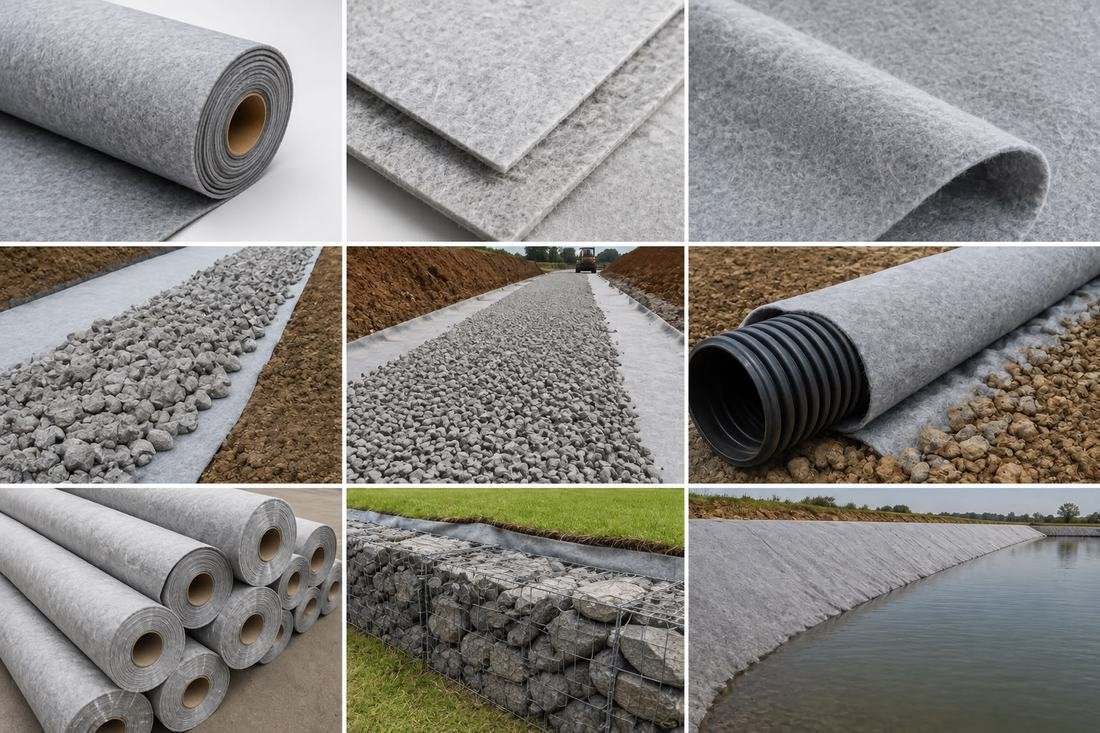
A nonwoven geotextile is made without weaving. Staple fibres are formed into a thick web and bonded, most often by needle punching, which tangles the fibres with barbed needles. The result is a soft, felt-like fabric with many small, irregular pores through its thickness. Our needle punched vs thermal bonded guide explains the bonding step.
You can tell them apart by eye: a woven shows a criss-cross grid of tapes or yarns; a nonwoven looks and feels like felt.
Side by side
| Feature | Woven geotextile | Nonwoven geotextile (needle punched) |
|---|---|---|
| Structure | Interlaced tapes or yarns, thin | Entangled fibres, thick and felt-like |
| Strength | High tensile strength at low stretch | Lower tensile strength, stretches more before breaking |
| Water through the fabric | Usually lower for slit film; higher for monofilament | High, through many small pores |
| Water along the fabric | Very little | Yes, a thick nonwoven can carry water in its own plane |
| Filtration of fine soil | Depends on the opening size; slit film can blind | Good: the depth of the felt holds soil while water passes |
| Cushioning and puncture protection | Limited, the sheet is thin | Good, from its thickness |
| Fit to uneven ground | Stiffer | Drapes and conforms |
| Typical first choice for | Reinforcement and stabilisation, where strength matters most | Drainage, filtration, separation and protection |
These are general tendencies. Within each type, the grade, the polymer and the design values decide the actual performance.
Which one for which job
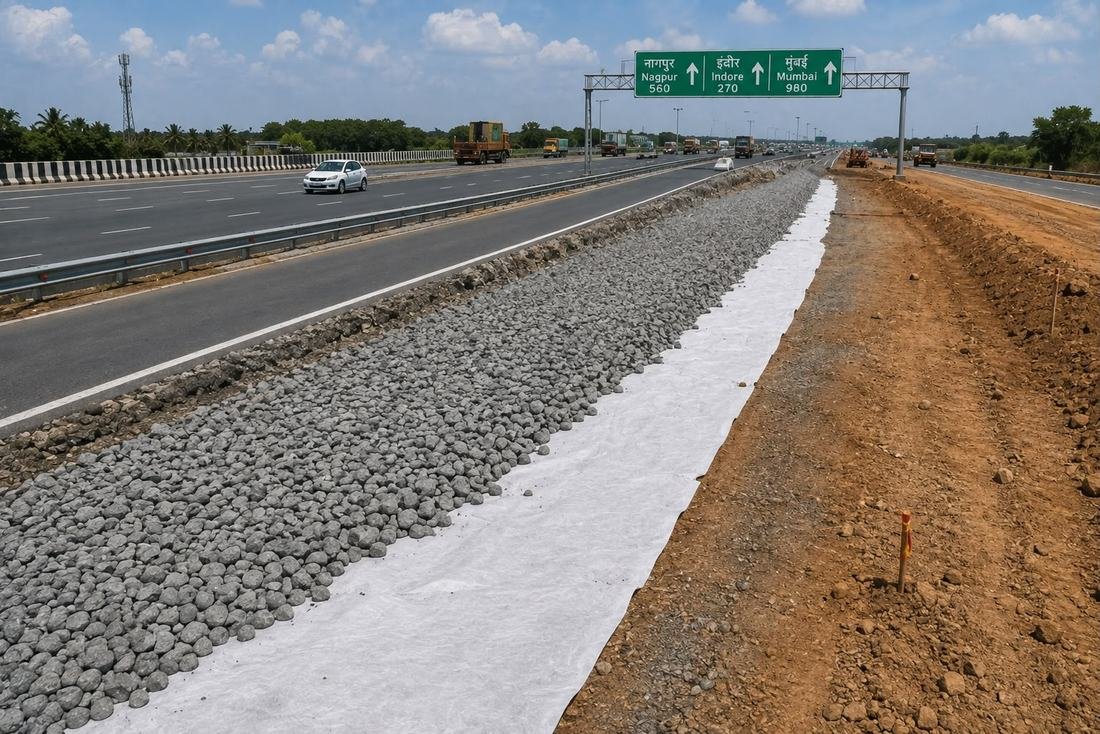
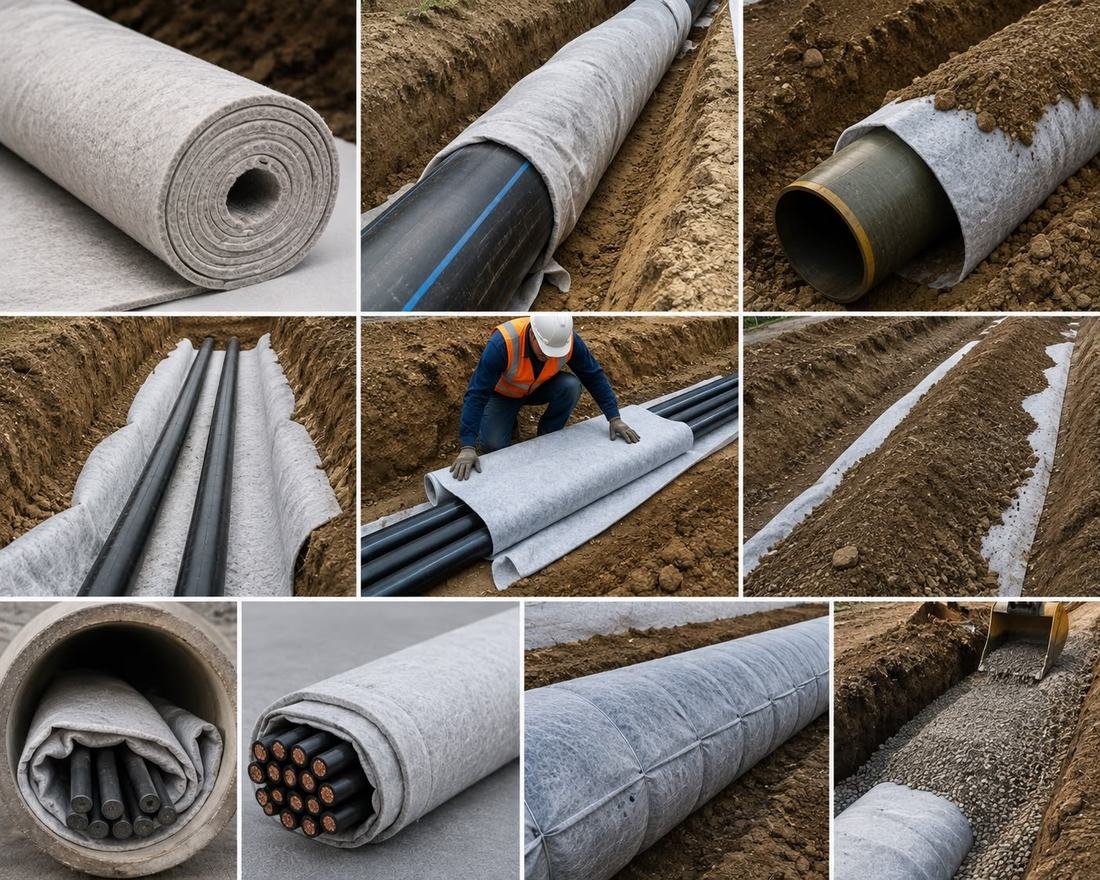
- French drains, pipe wrapping, drainage layers behind walls: nonwoven, because water has to pass through and along the fabric while soil stays out
- Separation under roads, yards and railway ballast: both are used; nonwoven where the subgrade is wet or drainage matters, woven where the design needs more strength
- Reinforcement and stabilisation over very soft ground: woven (or geogrid), because it takes load at low stretch
- Protection of a geomembrane in canals, ponds and landfills: nonwoven, because the thick felt cushions the liner against stones
- Slope and bank protection under stone or riprap: nonwoven or a monofilament woven, as the designer specifies; slit-film woven is generally avoided where filtration matters
- Silt fences on construction sites: usually woven
The guides for each use go into more detail: roads, drainage and erosion control, railway track, canal and pond lining and retaining walls.
Why "the same GSM" does not make them equal
A woven and a nonwoven of the same GSM behave very differently. A light woven can be stronger in tension than a much heavier nonwoven, while the nonwoven drains and filters far better. Comparing the two by weight or by price per kilogram misleads.
Compare them on the properties the design asks for: tensile strength and elongation, puncture resistance, opening size, permeability, and for drainage layers the flow along the fabric. Our GSM guide explains what weight does and does not tell you.
What to put in your specification
- The function: separation, filtration, drainage, reinforcement or protection
- Woven or nonwoven, if the design fixes it
- The test values the design requires (strength, puncture, opening size, permeability), with the test standard named
- Roll width and length, and the area to cover
- For public works, the clause of the tender or standard specification; confirm the current edition with your project engineer
If you are unsure which type the job needs, ask the designer before ordering. A wrong type is not fixed by a heavier grade.
What we supply
We make needle punched nonwoven geotextile in PP (virgin or recycled) and polyester, from 100 to 1200 GSM, in rolls 5.0–5.2 m wide, with a standard roll length of 50 m and other lengths on request. We do not make woven geotextile. If your design calls for a woven, we will say so rather than offer a nonwoven in its place.
See PP geotextile fabric for civil works and drainage and erosion control geotextile, or send your specification through the enquiry form. Samples are free.
Questions
What is the difference between woven and nonwoven geotextile?
A woven geotextile is made by interlacing tapes or yarns on a loom; it is thin and strong in tension. A nonwoven is made by bonding a web of fibres, usually by needle punching; it is thick and felt-like, and lets water pass through and along it while holding soil back.
Which is better, woven or nonwoven geotextile?
Neither in general; they do different jobs. Woven suits reinforcement and stabilisation, where strength at low stretch matters. Nonwoven suits drainage, filtration, separation on wet ground and protection of liners.
Which geotextile is used for drainage?
Nonwoven, usually needle punched. Its thick, porous structure lets water flow through and along the fabric while it filters fine soil. See our drainage and erosion control guide.
Which geotextile is used under roads?
Both are used for separation under roads. Nonwoven is common where the subgrade is wet or soft and drainage matters; woven is chosen where the design needs more tensile strength. The project engineer sets the type and grade. See our road construction guide.
Do you make woven geotextile?
No. We make needle punched nonwoven geotextile only. If your design needs a woven fabric, we will tell you so.