Before the rolls arrive
- Check the drawing: where the fabric goes, which way the rolls run, and the overlap or seam the specification asks for
- Plan roll layout against the area, so joints fall where they are easiest to make and waste is low
- Have a dry, flat place to store rolls off the ground, under cover
To work out how many rolls an area needs, see geotextile roll weight and coverage.
Prepare the ground
Clear roots, large stones and debris, fill holes and ruts, and trim the surface to the level shown on the drawing. Sharp objects left on the ground press into the fabric once fill goes on top. On very soft ground, the engineer may accept some unevenness rather than disturb the soil; follow their instruction.
Roll out and overlap
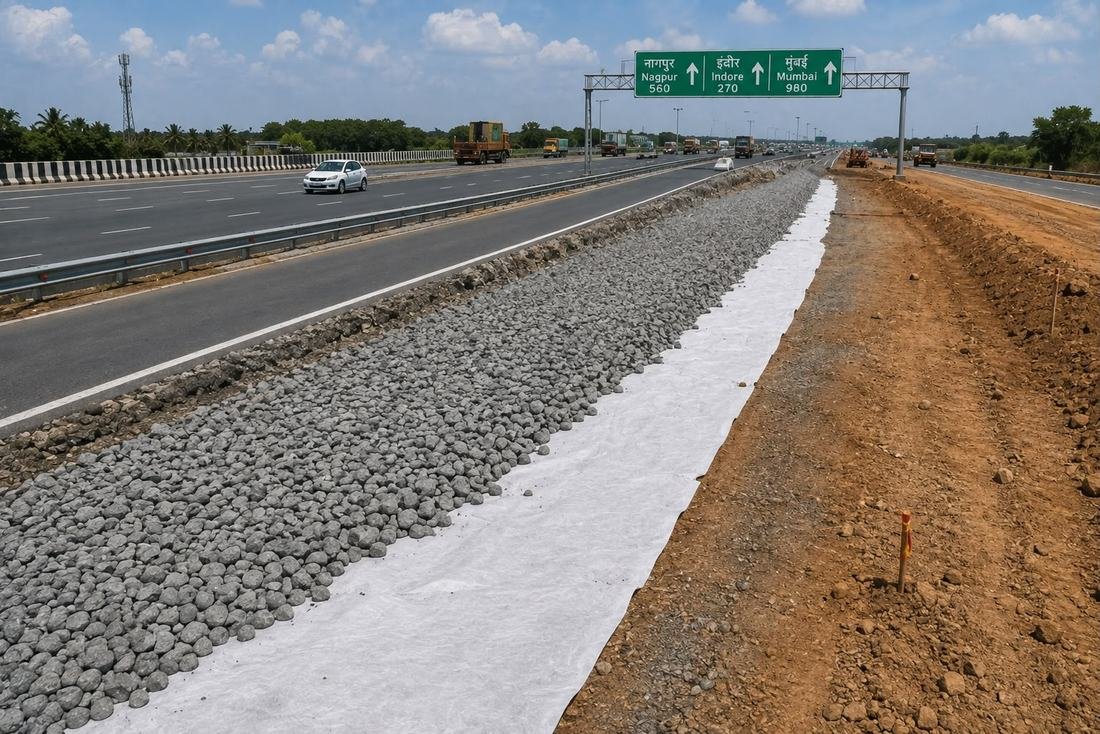
- Unroll the fabric loose and flat, in full contact with the ground, without wrinkles or folds; do not stretch it tight unless the specification says so
- Overlap adjacent rolls by the width the specification sets; softer ground usually calls for wider overlaps, and some projects sew joints instead
- Lap the upstream or uphill roll over the downstream one, so water and fill run over the joint rather than into it
- Lap in the direction the fill will be pushed, so the leading edge is not lifted open
Hold it in place
Wind lifts loose fabric easily. Pins, U-shaped staples, sandbags or a little fill are used to hold edges and overlaps until cover is placed. On slopes, the top edge is usually buried in an anchor trench so the fabric cannot slide down; the trench size comes from the drawing.
Place fill without damaging the fabric
- Tip fill onto fill already placed and push it forward over the fabric, rather than tipping directly onto the fabric
- Do not drive vehicles or tracked plant directly on uncovered fabric
- Place the first layer at the thickness the specification sets before compacting
- Do not drop large stone from height onto the fabric
If the fabric is torn or punctured during placing, cover the damaged area with a patch of the same fabric, overlapping it on all sides as for a normal joint, or as the specification sets out.
Sunlight and storage
Synthetic geotextiles weaken under long exposure to sunlight, and polypropylene in particular. Keep rolls wrapped until they are used, unroll only what can be covered soon, and cover laid fabric within the time the specification allows. The nonwoven geotextile guide covers how PP and polyester compare.
Ordering to suit the site
Tell us the roll width and length that suit your crew and your layout; we produce rolls up to 5.0–5.2 m wide and can slit narrower. Send the application, GSM and quantity through the enquiry form; samples are available on request.
Questions
How much should geotextile rolls overlap?
Your project specification sets it. Overlaps are generally wider on soft ground and where the fabric is not otherwise fixed, and some projects sew joints instead of overlapping. Lap the uphill or upstream roll over the downstream one.
Should geotextile be pulled tight when laying?
For separation and filtration work it is normally laid flat and loose, in full contact with the ground, without wrinkles. Follow the specification where it says otherwise.
Can trucks drive on geotextile?
Not directly on uncovered fabric. Fill is usually pushed forward over the fabric from fill already placed, and vehicles run on the fill once it is at the specified thickness.
How long can geotextile be left in the sun?
As short a time as possible. Synthetic geotextile, especially polypropylene, weakens under long sun exposure, so the project specification normally limits how long it can stay uncovered. Keep rolls wrapped until use.
How is a torn geotextile repaired on site?
Usually by laying a patch of the same fabric over the damage, overlapping it on all sides as for a normal joint, unless the specification sets another method.