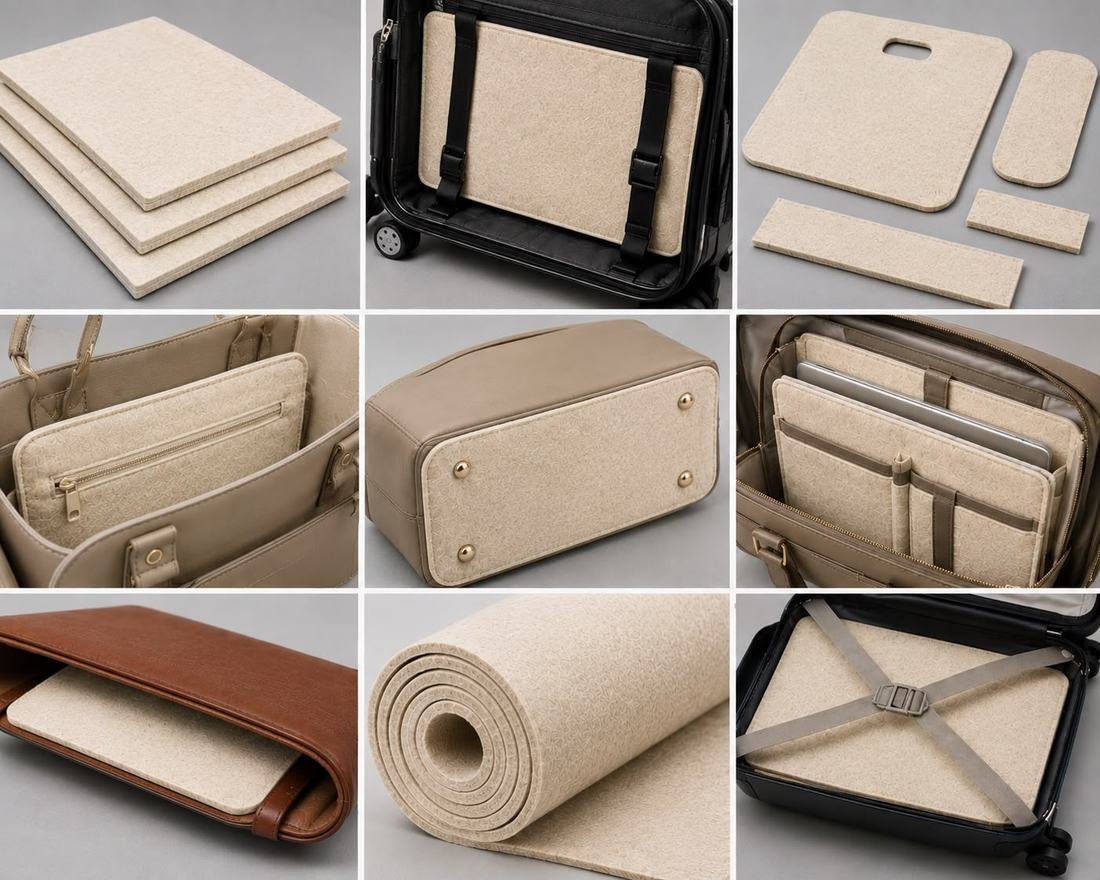
Where the felt goes
| Part of the bag | What the felt does |
|---|---|
| Front, back and side panels | Gives the panel body so it stands up rather than collapses |
| Base | Adds firmness and cushioning where the bag is set down |
| Laptop and tablet sleeves | Cushions the device against knocks |
| Organiser pockets and dividers | Keeps compartments upright and separate |
| Straps and handles | Pads and spreads the load across a wider area |
| Cases and pouches | Lines and protects the contents from scratches |
Felt, foam or board
| Feature | Needle punched felt | Foam | Rigid board |
|---|---|---|---|
| Shape | Firm but flexible | Soft, springs back | Stiff, holds a flat shape |
| Sewing | Stitches cleanly, holds the seam | Can tear at the needle line | Hard to stitch through |
| Bonding and lamination | Takes adhesive and heat lamination well | Depends on the foam | Usually glued, not laminated |
| Where it suits | Panels, bases, dividers, sleeves | Padding where softness matters most | Hard-wearing bases and frames |
Many bags use more than one: board in the base, felt in the panels, foam in the laptop sleeve. The table is about where felt earns its place, not a claim that it replaces the others everywhere.
How stiffness is set
A felt gets stiffer as its weight, thickness and density go up, and the fibre and process matter too. Thermal bonded felt, where low-melt fibre is heat-set through the web, is generally firmer for the same weight than a felt that is only needle punched. Both are processes we run, so the felt can be built to the stiffness the panel needs.
There is no single right GSM for a bag. A small pouch and a cabin case ask for very different panels, so start from a sample of the material you use today, or from the feel you want, and we will match or adjust it. The GSM guide explains what the number does and does not tell you.
Converting it in your factory
- Cut by knife, die or press to your pattern
- Stitched into the panel with the outer fabric and lining
- Laminated or bonded to fabric, PU, PVC or leather
- Embossed where a surface pattern is wanted
Tell us how the felt is cut and joined in your line. A felt that will be heat-laminated, for example, is built differently from one that is only stitched. Our luggage and bag support felt page lists the material in more detail.
What we supply, and what we do not
We supply the felt in rolls, slit to the width you need, in polyester, PP or blends, from 100 to 1200 GSM, with thickness and colour set per order. We do not make bags, cut components, or the fabrics, foams and boards used alongside the felt.
What to send with your enquiry
- The product: backpack, luggage, laptop bag, case, pouch or organiser
- Which part the felt goes in, and how stiff or soft it should feel
- A sample of the material you use today, if you have one
- GSM and thickness if you know them, and the colour
- How it is converted: cut, stitched, laminated, bonded or embossed
- Roll width, quantity, and the delivery location
Send it through the enquiry form; samples are available on request. The quote checklist covers the general details we ask for.
Questions
What material is used inside bags to give them shape?
Needle punched nonwoven felt is commonly used between the outer fabric and the lining to give panels body and structure. Bags often combine it with foam for padding and rigid board for the base.
What GSM felt is used for bags and luggage?
It depends on the product and the part. A pouch and a cabin case need very different panels. Send a sample of the material you use or describe the feel you want, and we will match it from our 100 to 1200 GSM range.
Is felt or foam better for a laptop bag?
Many laptop bags use both: foam where softness matters most, felt where the panel needs body and clean stitching. The design decides; we supply the felt.
Can bag support felt be laminated to fabric?
Yes. It can be laminated or bonded to fabric, PU, PVC or leather, as well as stitched. Tell us the method so the felt is built for it.
Do you supply cut components or finished bags?
No. We supply felt in rolls, slit to width. Cutting, stitching and assembly are done by the bag maker.