Why nonwoven rather than woven
A nonwoven has no warp and weft, so it has no grain to line up and it does not fray at a cut edge. That makes it cheap to nest and cut, and it means a die-cut component holds its outline without an overlocked edge.
Needle punching also lets thickness and firmness be set by the process rather than by the yarn, so one fibre can produce a soft lining or a firm support simply by being needled differently. For how that compares with the other main route, see needle punched vs thermal bonded.
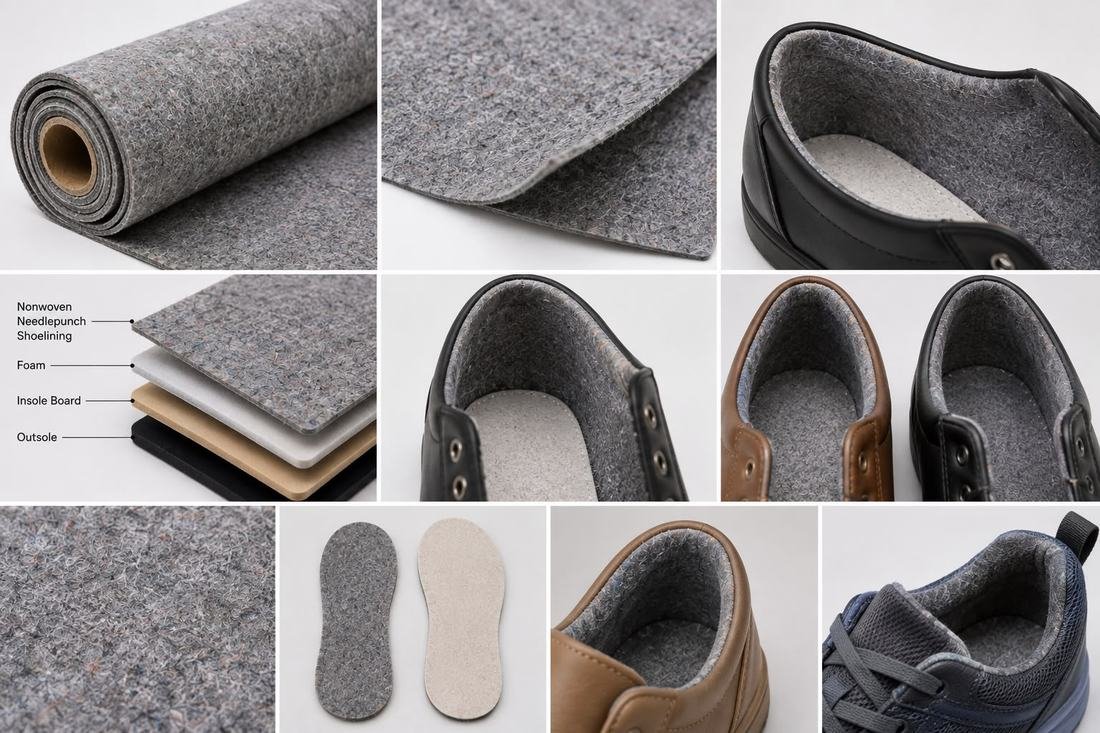
Inside a shoe: where the nonwoven goes
- Inner lining — the face that sits against the foot, where softness and abrasion resistance matter
- Shoe uppers — as a backing layer behind the visible material
- Insoles — cushioning under the foot
- Heel counters — holding the back of the shoe in shape
- Toe-puff support — keeping the toe box from collapsing
- Slipper lining — soft, light and inexpensive to cut
The same material runs across sports, safety and casual footwear. Our nonwoven shoe lining fabric is a polyester needle punched felt made for these components.
What a footwear lining has to deliver
A lining fails in service in predictable ways: it wears through where the foot moves against it, it holds damp, or it packs down and loses its cushioning. So three properties get checked first — abrasion resistance at the contact face, breathability through the fabric, and recovery after repeated compression.
Polyester is the usual fibre here because it recovers well and resists abrasion, and because it is stable when laminated. Weight and thickness then tune the balance between a thin lining that keeps the shoe’s internal volume and a thicker one that cushions.
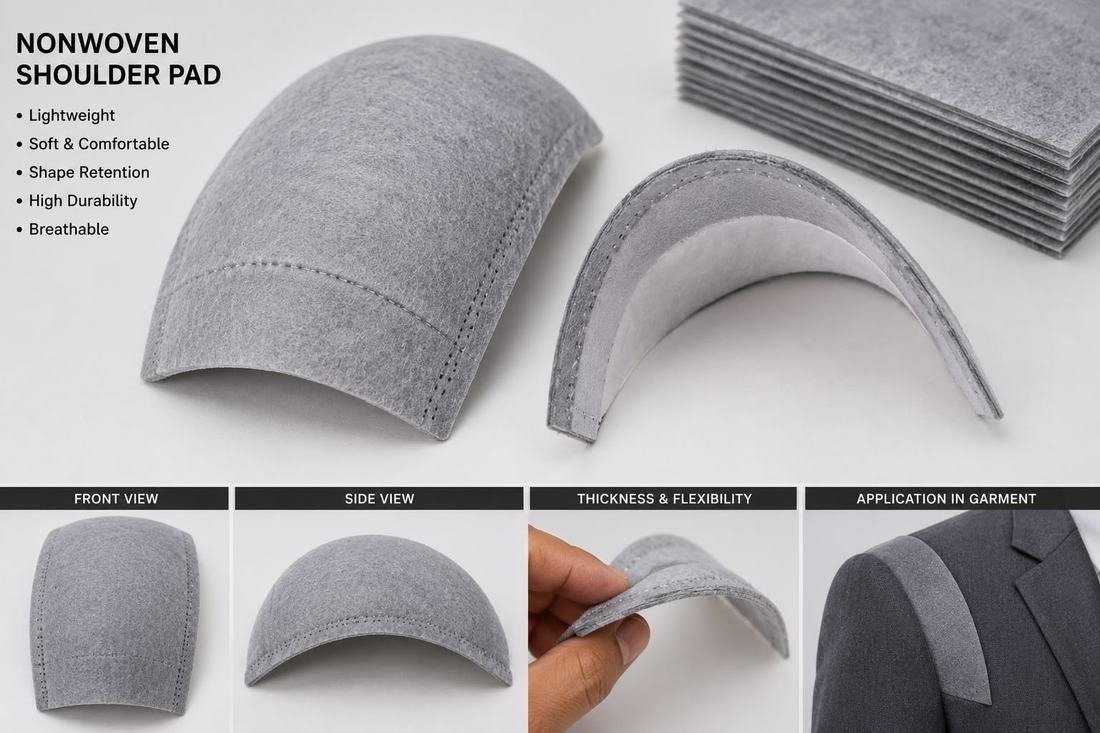
Inside a garment: shoulder pads and structure
A shoulder pad has the opposite problem to a lining. It is not hidden from the eye — its shape is the garment’s shape — so it has to hold a smooth, defined form through wear and cleaning without reading as bulk from the outside.
That calls for resilience rather than softness alone: the fabric must come back after being compressed, and it must not crease into a line that shows through the cloth. Our shoulder pad nonwoven fabric is a lightweight polyester felt made for blazers, suits, coats, jackets, uniforms and ladies’ fashion garments.
Weight, thickness and colour
Footwear and apparel components live at the light end of the nonwoven range, where small changes in weight are felt immediately — in how a lining breathes, how a pad sits, how a stack of blanks cuts. Material is made to order, so weight and thickness are specified for the component rather than chosen from a stock list; GSM in nonwoven fabric explains how the two relate.
Colour is a real consideration in these products, because a lining can be visible at the shoe’s opening and a pad can shadow through a pale garment. Colour, like weight and width, is set to requirement.
Processing: cutting, stitching, laminating, bonding
These components are rarely used as supplied. They are die-cut or cut on a cutter, stitched, laminated to foam or to a face fabric, and sometimes moulded or bonded into an assembly. A felt that behaves well in the roll can still misbehave on the line — fraying at a die edge, shifting under a laminating head, or shrinking with heat.
That is the strongest argument for sampling. Samples are available on request, and the useful test is not a handfeel but a short run through your own cutting, stitching and lamination steps.
What to send with your enquiry
- The component — lining, insole, heel counter, toe puff, upper backing, shoulder pad or interlining
- GSM and thickness, or a sample of the material you use today
- Colour, and whether the component is visible in the finished product
- Roll width, and whether you need it cut to a narrower width for your line
- The processing it must survive — die cutting, stitching, lamination, moulding, bonding
- Quantity per order or per month, and your destination country
An existing swatch is worth more than a paragraph of description, so send one if you have it. Use the enquiry form, or read the quote checklist first. Where no standard product fits, customised nonwoven fabric is developed to the application.
Questions
What fabric is used for shoe lining?
Needle punched polyester nonwoven is widely used for shoe linings, insoles, heel counters and toe-puff support, because it is soft at the contact face, resists abrasion, and cuts and stitches without fraying. GSM, thickness and colour are made to the component.
Is nonwoven shoe lining breathable?
A needle punched felt is a porous structure, so air and moisture vapour pass through it. How freely depends on the weight and how heavily the web is needled — a lighter, more open felt breathes more than a dense one. Tell us what the component needs and we will set the construction accordingly.
What GSM is used for shoulder pads?
It depends on the garment and the shape being built — a soft summer jacket and a structured blazer need different material. Shoulder pad fabric sits at the lighter end of our 100–1200 GSM range and is produced to the weight and thickness your pattern requires.
Can the fabric be laminated or bonded to other materials?
Yes. These felts are made to be cut, stitched, laminated and bonded with other footwear and garment materials. Lamination behaviour depends on the fibre and the adhesive system, so trial a sample through your own process before committing.
Can you supply it in our colour and cut width?
Colour, GSM, thickness, width and roll length are all made to requirement. Rolls are produced at 5.0–5.2 m width and can be cut down for your cutting or lamination line.