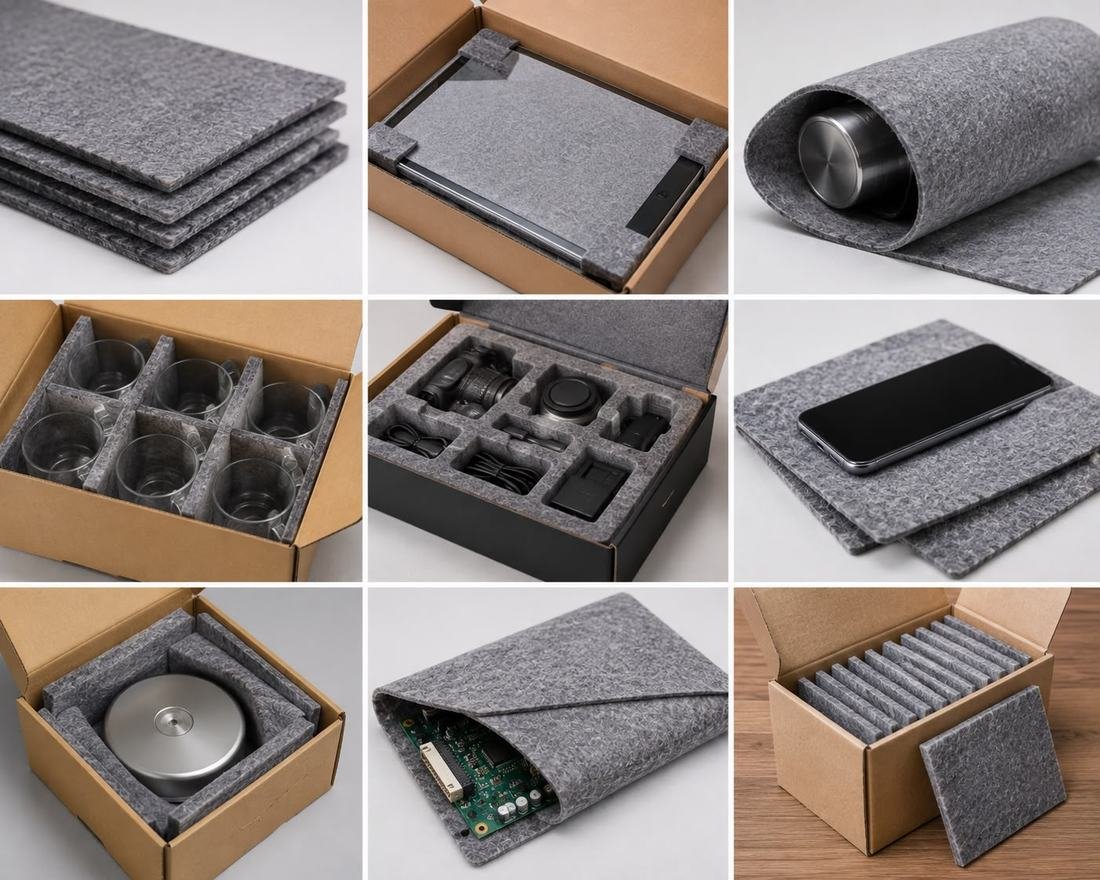
Where protective felt is used
- Interleaving between stacked sheets, panels and glass
- Lining crates, trays, bins and returnable packaging
- Wrapping furniture, appliances and machined parts
- Pads on racks, fixtures and trolleys so parts do not rub on metal
- Separators between parts packed in the same box
In most of these the felt is not the whole pack. It is the layer that touches the product, inside a box, crate or stillage that takes the heavier loads.
Felt, bubble wrap or foam
| Feature | Needle punched felt | Bubble wrap | Foam sheet (e.g. EPE) |
|---|---|---|---|
| Contact surface | Soft fibres, no plastic film on the product | Plastic film | Smooth foam |
| Use | Reusable over many trips if kept clean | Usually single use | Reusable to a point |
| Converting | Cut, stitched, laminated or glued to a tray | Cut and taped | Cut, glued or moulded |
| Suits best | Scratch and scuff protection, returnable packs | Light, one-way shipments | Cushioning against impact |
Felt is mainly about protecting the surface. Where a part is heavy or fragile and needs real shock absorption, the pack usually adds foam or a moulded insert as well.
What to choose: weight, thickness, fibre and colour
A thin, light felt is enough to stop scuffs between flat sheets. A thicker, heavier felt gives more cushioning where parts are heavier or are moved around more. Polyester and PP are both used; the right one depends on the goods, the temperature in storage, and whether the felt is laminated or glued to something else. The polyester vs polypropylene guide sets out the differences.
Colour is worth deciding on purpose. Some packers want a light felt that shows dirt so it is changed in time; others want a dark one that looks clean for longer. Both can be made to order.
Test it against your own surface
Finishes differ. Before ordering in volume, put a sample against your actual product, stack and move it the way it travels, and check the surface afterwards. If the result is not right, the GSM, thickness or fibre can change before production; the felt is made to order.
What we supply, and what we do not
We supply protective felt in rolls, slit to width, from 100 to 1200 GSM, with thickness and colour set per order. We do not make boxes, crates, foam inserts or finished packaging; packers and converters build those with our felt. Details are on the packaging and protective felt product page.
What to send with your enquiry
- The goods and their surface finish: painted, polished, glass, wood, plastic
- How the felt is used: interleaving, lining, wrapping or padding
- Single-use or returnable packaging
- GSM and thickness if you know them, otherwise the weight and size of the parts
- Colour, roll width, quantity, and the delivery location
Send it through the enquiry form; samples are available on request. The quote checklist covers the general details.
Questions
What is protective felt used for in packaging?
It is the soft layer that touches a finished surface, used for interleaving stacked sheets and panels, lining crates and trays, wrapping furniture and machined parts, and padding racks and trolleys so parts do not scratch.
Is felt better than bubble wrap?
For scratch and scuff protection, and for returnable packaging used over many trips, felt is often preferred because it is soft against the surface and reusable. For light one-way shipments, bubble wrap is common. Heavy or fragile parts often need foam as well.
Can packaging felt be reused?
Yes. Needle punched felt can be reused over many trips if it is kept clean and dry, which is why it is common in returnable crates and trays.
What GSM felt should I use for packaging?
A light felt is often enough to stop scuffs between flat sheets; heavier felt gives more cushioning for heavier parts. Test a sample against your own product. We produce from 100 to 1200 GSM.
Do you make finished packaging?
No. We supply felt in rolls, slit to width. Packers and converters make the crates, trays and inserts.