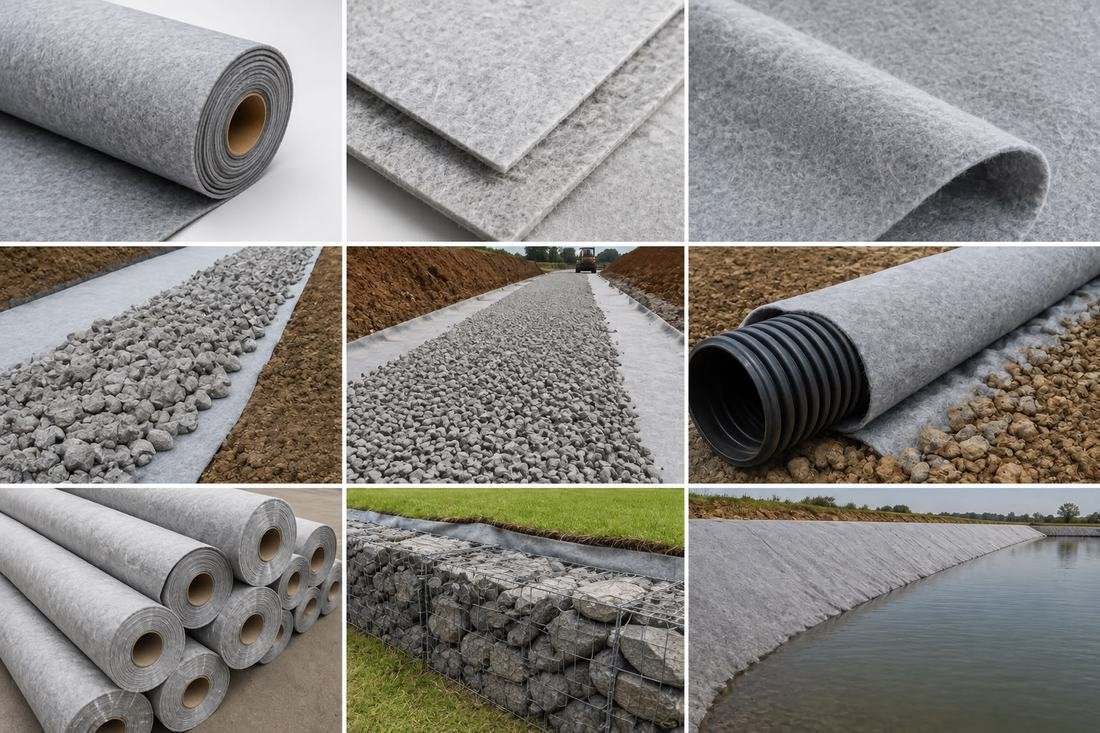
The layers, bottom to top
| Layer | What it is | Where nonwoven felt comes in |
|---|---|---|
| Structural slab | The roof or terrace slab, with its slope to the outlets | Not applicable |
| Waterproofing | The membrane or coating that keeps water out of the building | Not supplied by us |
| Protection layer | A layer that guards the waterproofing from stone, tools and roots of the layers above | A heavier nonwoven felt is commonly used here |
| Drainage layer | Gravel, a drainage board or cells, which carry excess water to the outlets | Not supplied by us |
| Filter layer | A fabric between the drainage layer and the soil | A nonwoven geotextile |
| Growing medium and plants | The soil or substrate and the planting | Not applicable |
Not every terrace garden has every layer. A light planter-based garden may use fewer, and a heavy roof garden more. The designer sets the build-up.
The filter layer under the soil
Watering and monsoon rain move fine particles down through the soil. Without a filter, they settle into the drainage layer and clog it, and the water that should drain away stays in the roots. A nonwoven geotextile lets water pass and holds the fine soil back. That is the filtration role described in the nonwoven geotextile guide, here applied at a small scale on a roof.
The protection layer over the waterproofing
Waterproofing on a terrace can be damaged by a dropped tool, a stone in the drainage layer or the edge of a drainage cell. A needle punched felt laid over the waterproofing, under the drainage layer, spreads the point loads and cushions the membrane. How heavy it should be depends on what sits on top of it. Some waterproofing systems specify their own protection layer; where yours does, follow the system supplier rather than this page.
Why monsoon changes the choice
- Heavy monsoon rain sends a lot of water through the build-up in a short time, so the filter has to pass water freely and not clog
- Standing water on a roof is a leak risk, so the drainage path to the outlets has to stay open
- Dry summer months mean the soil is watered by hand or by drip, which also carries fines down
- A fabric that is too fine can clog; one that is too open lets soil through. The right balance comes from the soil and the drainage layer, so confirm against a sample
We do not give a single weight or opening size for all roofs. Use the value in your specification.
Laying it
- Keep the slab, waterproofing and any testing finished and signed off before the felt goes on
- Lay the protection felt flat and loose over the waterproofing, with the overlap the specification sets
- Place the drainage layer, then the filter fabric over it, running the filter up the edges so soil cannot wash around it
- Bring the soil in without dragging heavy plant over bare fabric
- Keep the fabric away from open edges and outlets, so that the drainage path is not blocked by folded fabric
Check roof load limits and the weight of wet soil with the structural engineer; that is a structural question this page does not answer. Site steps for laying are in how to install nonwoven geotextile.
What to ask for
- Which layer the fabric is for: protection, filter, or both in separate rolls
- Fibre: polyester or polypropylene, as the specification calls for
- Weight (GSM) for each layer, set by the designer; confirm against a sample
- Roll width and length to suit the terrace; see roll weight and coverage for working out the quantity
Send the application, the weight and the quantity through the enquiry form. Samples are free, to any location.
What we supply, and what we do not
We make needle punched and thermal bonded nonwoven fabric, which is what goes in the protection and filter layers. We do not supply waterproofing membranes or coatings, root barriers, drainage boards or cells, soil or planters, and we do not make woven geotextile, geogrid or geomembrane. For those you will buy from the relevant supplier. We also do not offer installation.
Questions
Is geotextile used on terrace gardens?
Yes, commonly as a filter layer between the drainage layer and the soil, and sometimes as a protection layer over the waterproofing. The roof designer sets which layers are used.
What does the filter fabric do in a green roof?
It lets water pass down to the drainage layer while holding the fine soil back, so the drainage layer does not clog.
Can geotextile replace waterproofing on a terrace?
No. A nonwoven felt is permeable and is not a waterproofing layer. It protects or filters; the waterproofing is a separate membrane or coating.
Does geotextile stop roots damaging the waterproofing?
Do not rely on it for that. Root protection is a separate product, usually a root-resistant barrier or a root-resistant waterproofing, which we do not supply.
Which GSM should I use on a terrace garden?
It depends on the layer, the soil and the drainage build-up, so we do not give a number here. Use the value in your specification and confirm against a sample.
Do you supply drainage boards or waterproofing for terrace gardens?
No. We make needle punched and thermal bonded nonwoven fabric only.