What goes wrong on an unpaved site road
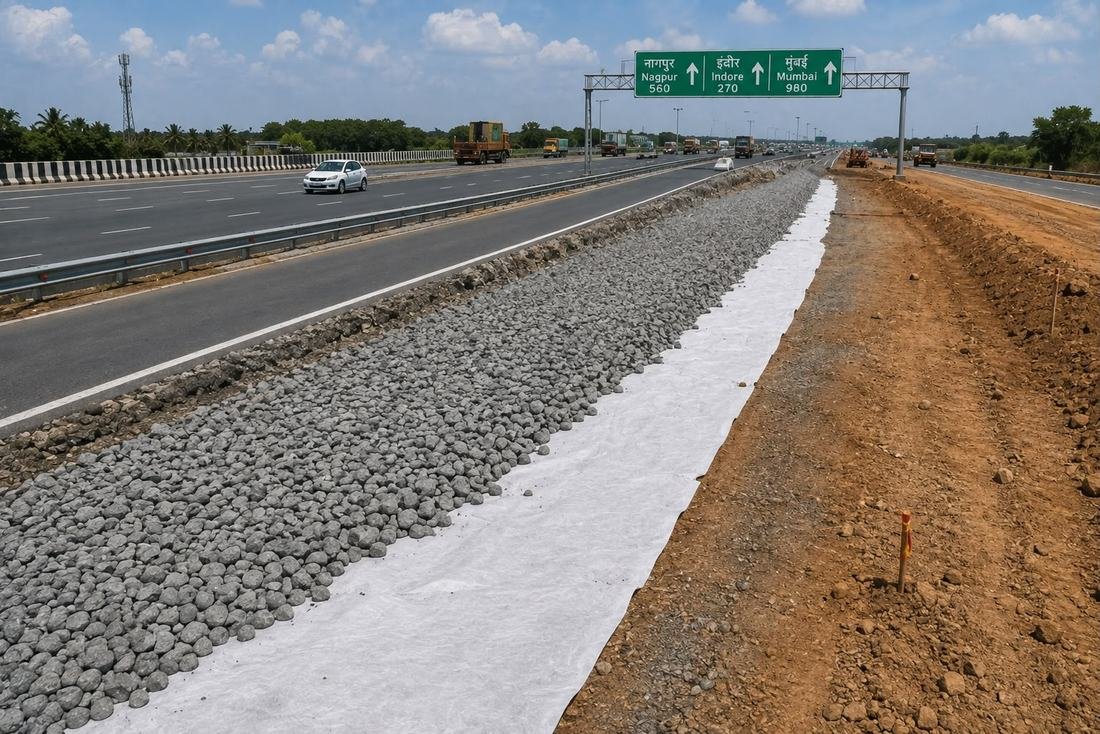
The stone layer is placed on soil that looks firm when dry. In the first rains the soil softens, the heavy plant presses the stone down into it, and soil works up into the stone. Ruts form, the road needs topping up again and again, and trucks start to get stuck. The cost is not only the stone, but the delay to the construction programme. A geotextile between the soil and the stone keeps the two apart, which is the separation role described in the geotextile for road construction guide.
Where a nonwoven is used at a solar plant
| Where | What the fabric does | Typical concern |
|---|---|---|
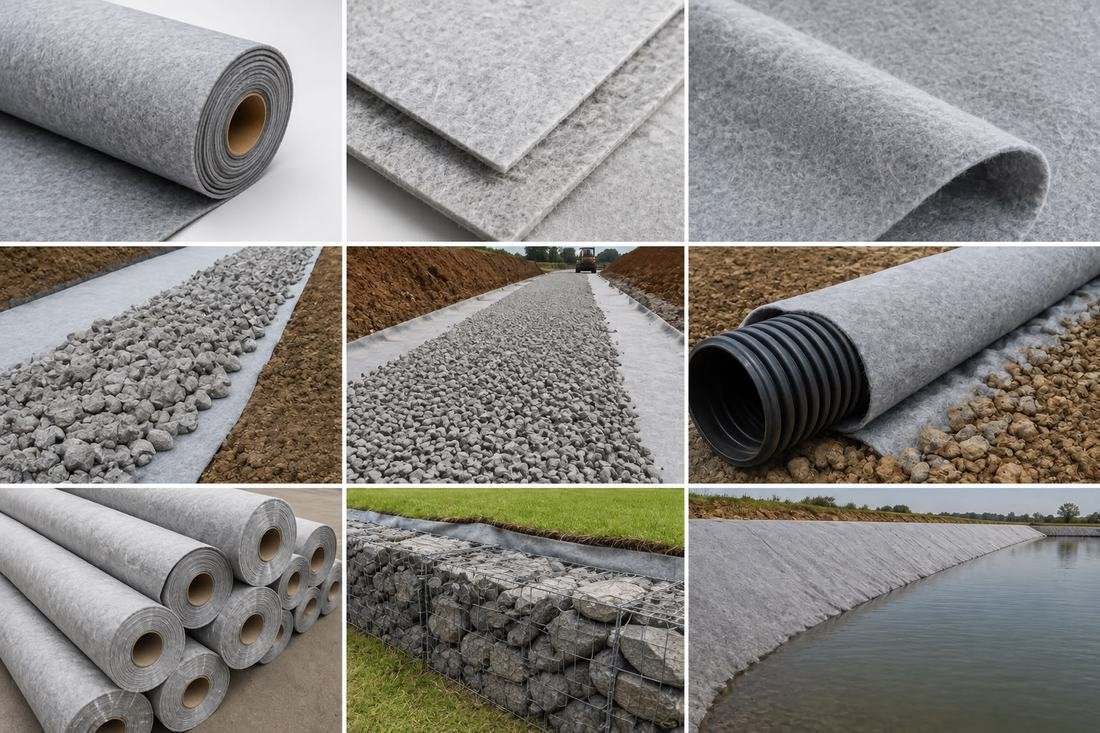
| Main access road from the gate | Separates the stone from the subgrade; lets water out | Heavy trucks and plant, repeated passes |
| Internal roads between blocks | Same, under a thinner stone layer | Black cotton or clayey soil that softens when wet |
| Crane and piling platforms | Separates the working platform stone from the soil | Concentrated loads in one place |
| Cable trenches and drains | Filters around stone-filled trenches so they do not clog with fines | Silt washing in during monsoon |
| Stormwater channels and culvert ends | Filter under stone lining | Scour where water speeds up |
Not every road at every plant needs a fabric. On firm, well-drained soil it may add cost without much benefit. The soil investigation and the designer decide.
What it does not do
A nonwoven separates and filters. It does not make soft ground strong. On very soft ground, designs often call for a thicker stone layer, soil treatment, or a different product, such as a woven geotextile or geogrid, that is specified for stabilising a weak subgrade. We make none of those. If your road design needs reinforcement, say so to the engineer, and use a nonwoven only where the drawing asks for separation or filtration. The woven vs nonwoven guide explains how the two differ.
Why monsoon decides the specification
- Soil strength can drop sharply once it is wet, so the road has to be designed for the wettest condition, not the dry one
- Construction traffic is heaviest during the build, often before any permanent surface goes on
- Water has to leave the road, so the fabric must pass water freely and not clog
- Silt from unpaved areas washes into drains and trenches, so filter fabric around them matters
We do not give one weight for every site. Use the value in your specification, and confirm against a sample before bulk.
Laying it on a large site
- Trim and compact the subgrade, and remove sharp stones, roots and debris
- Roll out the fabric flat and loose, in contact with the ground, without folds
- Overlap rolls by the width the specification sets, with the lead roll over the next in the direction the stone will be tipped
- Tip stone onto stone already placed and push it forward over the fabric; do not drive plant over bare fabric
- Keep to the stone layer thickness the drawing sets before compacting
- Cover the fabric soon after laying, because sunlight weakens synthetic fibre, polypropylene in particular
The general site steps are in how to install nonwoven geotextile. On a large plant the quantity is big, so work out the rolls from the road lengths: see roll weight and coverage.
What to settle before you order
- The road areas that get fabric, from the drawing, with lengths and widths
- Fibre: polyester or polypropylene, as the specification calls for
- Weight (GSM) and any test values the specification sets
- Roll width and length to suit the road widths, so overlaps and waste work out
- Delivery location and timing against the construction programme; tell us when sending the enquiry
If the project follows a client, EPC or agency specification, confirm the current edition of any standard it names with your engineer; we do not quote a standard on this page.
What we supply, and what we do not
We make needle punched and thermal bonded nonwoven fabric, which is what goes under the road and around the trenches. We do not make woven geotextile, geogrid, geocell, geomembrane or drainage pipe, and we do not install. Send the application, the weight and the quantity through the enquiry form. Samples are free, to any location.
Questions
Is geotextile used for solar plant roads in India?
Yes, commonly as a separation layer under unpaved access roads and working platforms, and as a filter around cable trenches and drains. Whether it is needed on a given road is the designer’s decision.
What does geotextile do under an unpaved road?
It keeps the stone and the soil apart so the stone does not sink into soft ground and soil does not work up into it. It also lets water pass. It does not strengthen the soil.
Can geotextile be used on black cotton soil at a solar site?
It is commonly used as a separation and drainage layer over expansive soils. How the road is built on such soil is a design question for the engineer.
Is a nonwoven enough for very soft ground?
Not always. Very soft ground may need a thicker stone layer, soil treatment or a different product such as woven geotextile or geogrid, which we do not make. The engineer decides.
Which GSM should be used for a solar plant road?
It depends on the soil, the traffic and the stone, so we do not give a number here. Use the value in your specification and confirm against a sample before bulk.
Do you supply geogrid or woven geotextile for solar roads?
No. We make needle punched and thermal bonded nonwoven fabric only.