Key points
- Geotextile is permeable: it lets water through and holds soil back. Geomembrane is impermeable: it is the waterproof barrier.
- Geotextile is a fabric specified in GSM and test values; geomembrane is a plastic sheet (often HDPE) specified by thickness in millimetres.
- Use geotextile alone for drainage, filtration and separation. Use a geomembrane where liquid must be contained, with a nonwoven geotextile under and often over it as a cushion.
- No weight of geotextile makes it waterproof; a geomembrane laid without a cushion layer can be punctured by stones.
The one-line difference
A geotextile is meant to pass water. A geomembrane is meant to stop it. Everything else follows from that. If the design wants water to drain away while soil stays in place, it calls for a geotextile. If the design wants water, leachate or another liquid to stay in or stay out, it calls for a geomembrane.
Side by side
| Feature | Geotextile | Geomembrane |
|---|---|---|
| What it is | A fabric of synthetic fibres, nonwoven (needle punched) or woven | A continuous plastic sheet |
| Water | Permeable: water passes through it, and along a thick nonwoven | Impermeable: designed as a barrier to liquids |
| Common materials | Polypropylene, polyester | HDPE, LLDPE, PVC and other polymers |
| How it is specified | Mass per unit area (GSM) plus strength, puncture, opening size and permeability | Thickness in mm plus density, tensile, puncture and other sheet properties |
| Main jobs | Separation, filtration, drainage, protection, reinforcement (woven) | Containment and waterproofing |
| Joints on site | Overlapped, or sewn where the design requires | Welded (fusion or extrusion) and tested, so the barrier is continuous |
| Typical places | Roads, railways, drains, retaining walls, slopes, under paving | Ponds, canals, reservoirs, landfills, tailings, tunnels, secondary containment |
| Do we supply it? | Yes, nonwoven | No |
Because they are specified so differently, the two cannot be compared by weight or by price per square metre. A geomembrane is measured in millimetres of thickness; a geotextile in grams per square metre and test values. Our geotextile test methods guide explains the fabric values.
Which jobs need which
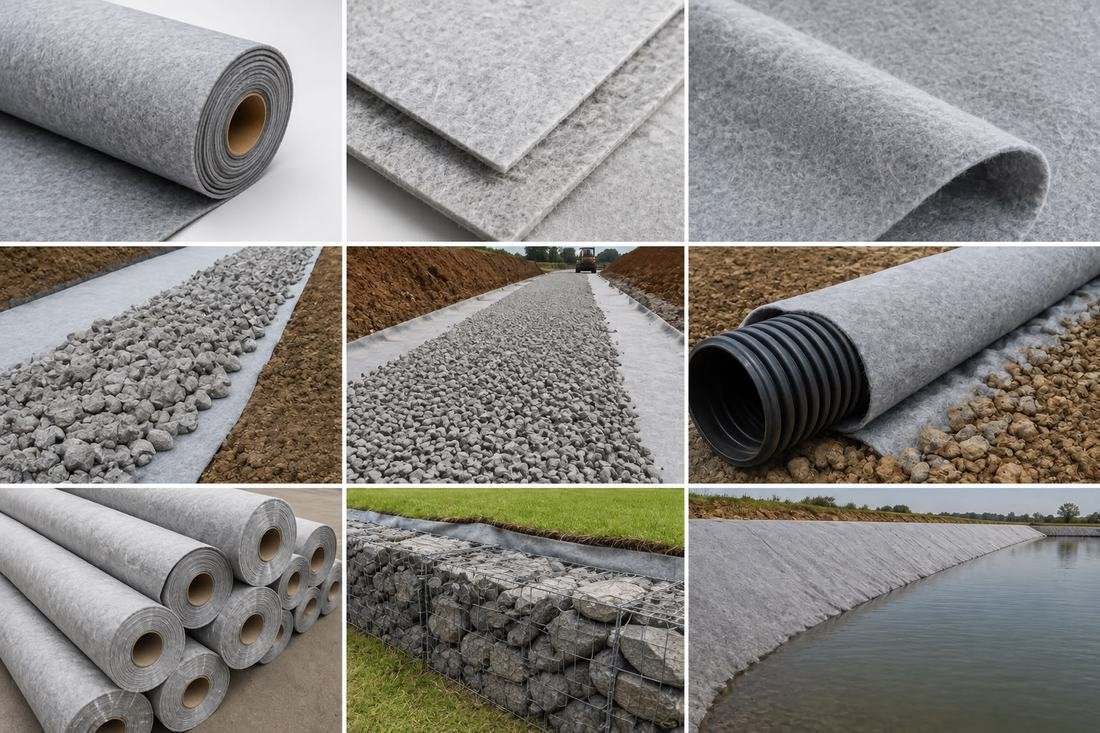
- Drainage behind a retaining wall, around a pipe drain or under a sports field: geotextile only. Water must get out. See retaining wall drainage.
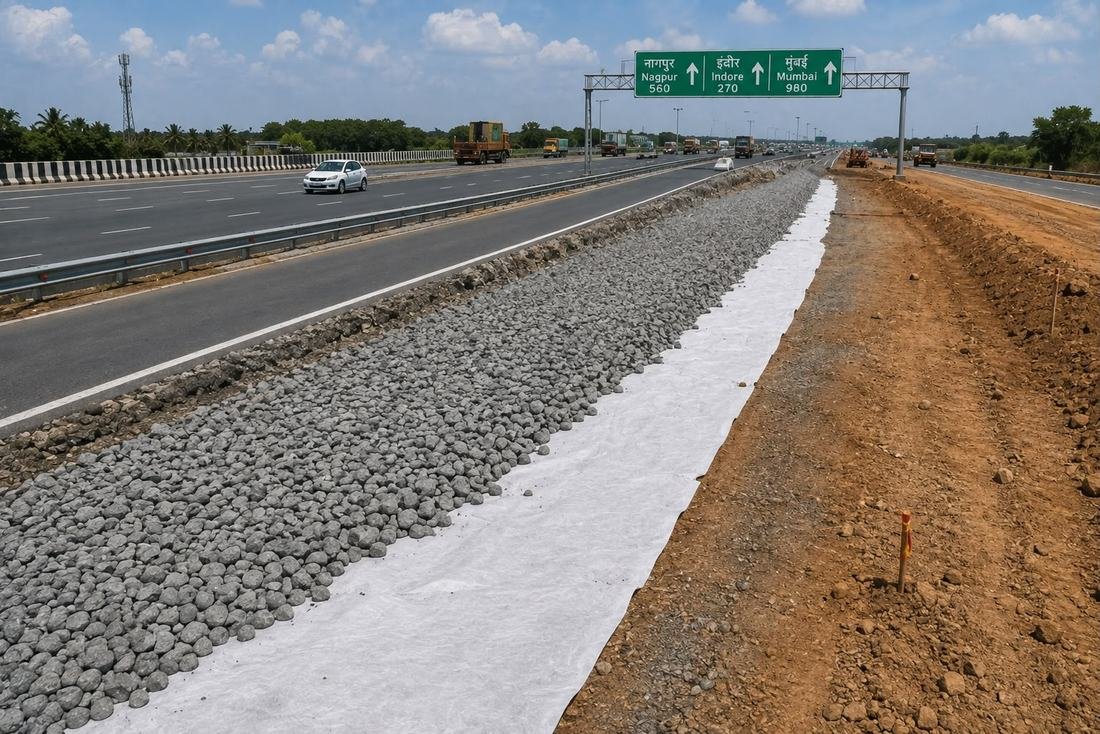
- Separation under a road, yard or railway ballast: geotextile only. See road construction.
- Erosion control under stone pitching or gabions: geotextile only, as a filter. See gabions and stone pitching.
- Farm ponds, water tanks, reservoirs and lined canals: geomembrane as the barrier, with nonwoven geotextile as the cushion. See canal and pond lining.
- Landfill cells, leachate ponds and mine tailings: geomembrane in a designed liner system, with geotextile for protection, filtration and separation. See landfill and mining.
- Green roofs and terrace gardens: a waterproofing layer on the slab, with a nonwoven geotextile protecting it and filtering the soil above the drainage layer. See green roofs.
- Tunnels: a waterproofing membrane, usually with a nonwoven fleece behind it against the rough rock or shotcrete. The design sets both.
Why lined works use both
A geomembrane is only as good as the surface it rests on and the material placed on it. Subgrades hold stones, roots and hard clods however well they are trimmed, and cover soil or stone on top adds more. Under load these press into the sheet, and a single puncture lets the liquid through.
A thick needle punched nonwoven laid under the geomembrane spreads those point loads, so the sheet is not pierced. Another layer is often laid on top before the cover soil or stone, for the same reason. In some systems the geotextile also drains gas or water from under the liner, or acts as a filter above it. The usual build-up, from the bottom, is: prepared subgrade, nonwoven geotextile, geomembrane, nonwoven geotextile, cover. Your drawing decides the actual layers.
Protection layers are often specified heavier than separation or drainage layers, because their job is to resist puncture. The design sets the grade, sometimes by a puncture or protection test rather than by GSM alone.
Common mistakes
- Using a geotextile to stop water. Even the heaviest nonwoven is permeable by design; it will not hold water in a pond or canal.
- Laying a geomembrane straight on the subgrade, with no cushion layer, to save cost. Stones and roots then puncture it under load.
- Choosing the cushion by price per square metre instead of the protection value the design needs.
- Covering a membrane with sharp stone directly. The upper protection layer is there for a reason.
- Asking for "geotextile membrane" in an enquiry. The phrase is used for both products; say whether you need the waterproof sheet or the fabric.
Geosynthetic clay liners and composites
Two other products sit between the two. A geosynthetic clay liner (GCL) is a layer of bentonite clay held between geotextiles; when wet the clay swells and forms a low-permeability barrier. A geocomposite bonds a geotextile to a drainage core or to a membrane, so two functions come in one roll. Both are designed products. We make neither, but our nonwoven is often used as the separate cushion, filter or separation layer next to them.
What to tell a supplier
- Which product you need: the waterproof geomembrane, the geotextile fabric, or both
- For the geotextile: its job (cushion, filter, separator), the GSM or test values in the design, fibre if fixed, and the area
- For the geomembrane: ask a geomembrane supplier for thickness, polymer and welding; we do not supply it
- The build-up drawing, so the geotextile grade matches the layer it sits in
What we supply
We make needle punched nonwoven geotextile in PP (virgin or recycled) and polyester, from 100 to 1200 GSM, in rolls 5.0–5.2 m wide, with a standard roll length of 50 m and other lengths on request. It is used as the cushion, protection, filter and separation layer around geomembranes as well as on its own. We do not make geomembrane, GCL or geocomposites. See PP geotextile fabric for civil works, or send your build-up through the enquiry form. Samples are free.
Questions
What is the difference between geotextile and geomembrane?
A geotextile is a permeable fabric: it lets water pass while it separates, filters, drains or protects. A geomembrane is an impermeable plastic sheet, often HDPE, used to contain or keep out water and other liquids.
Is geotextile waterproof?
No. A geotextile is permeable by design, whatever its weight. For waterproofing you need a geomembrane or another barrier; the geotextile then protects it.
Why is geotextile laid under a geomembrane?
As a cushion. A thick nonwoven spreads the load from stones and roots in the subgrade so they do not puncture the membrane. A second layer is often laid on top before the cover. See our canal and pond lining guide.
Which is used in a pond liner, geotextile or geomembrane?
Both. The geomembrane holds the water; a nonwoven geotextile under it, and often over it, protects it from puncture. The design sets the membrane thickness and the geotextile grade.
How is geomembrane thickness different from geotextile GSM?
Geomembrane is specified by sheet thickness in millimetres. Geotextile is specified by mass per unit area in g/m² together with strength, puncture, opening size and permeability values. The two numbers measure different things and cannot be compared.
Do you supply geomembrane?
No. We make needle punched nonwoven geotextile only, used as the protection, filter and separation layer with a geomembrane. The membrane itself comes from a geomembrane supplier.